Re:filtered #27: The house sets the odds
Welcome to the 27th edition of my monthly newsletter on journalism in a moment of systemic disruption.
The debate about the creator pivot tends to produce two camps: the converts and the skeptics. Neither is wrong. The creator economy is real; so are the opportunities it creates and the wreckage it leaves behind.
Some creators genuinely thrive, building durable relationships, keeping promises at a scale that still feels human. Others burn through their savings, their credibility, and their mental health chasing metrics that were unlikely to convert into anything stable.
Being social-first is both real and necessary, but the terms aren't yours. A creator pivot without a service strategy is a slot machine approach to self-expression: occasionally it pays out, mostly it takes. You keep pulling the lever because the alternative feels like giving up.
Here's a way of thinking about this moment from an earlier life as a reporter that comes from China's actual gambling world.
Macau is one of my favorite places in the world. People usually picture the faux Venice gondolas and Eiffel Tower, the lurid lights of the casinos, the nearly 30 million tourists mostly bussed in from the mainland.
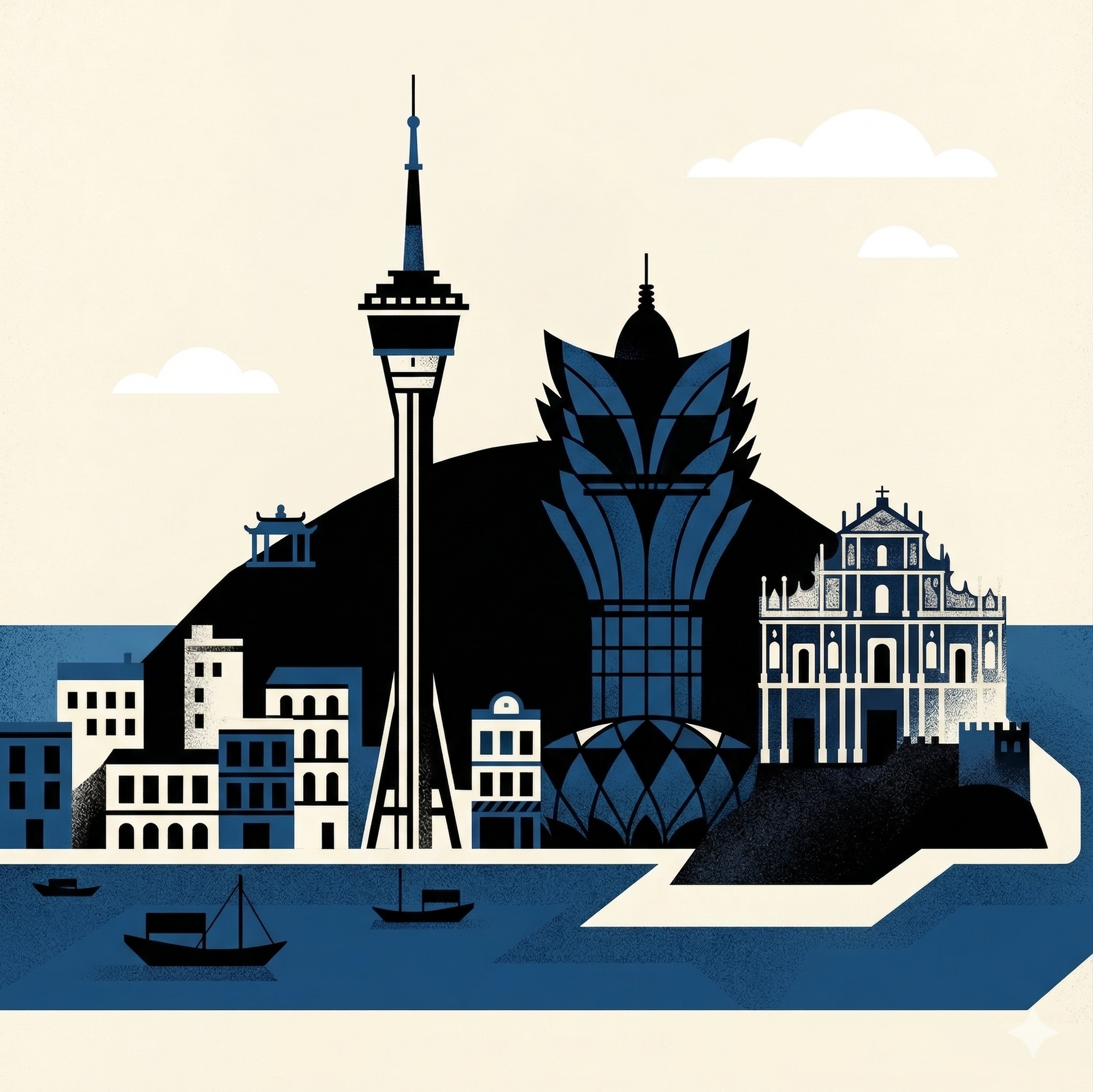
But there are also neighborhoods that feel like they have been watching the twentieth century and the first two and a half decades of the twenty-first without much aspiration or commentary. More than elsewhere, the stories there are not on the surface, and it feels like they never meant to be.
Macau holds memory beneath that commodified surface, the cobblestones, baroque facades consumed by banyan roots, a harbor that was once a global hub in the trade of porcelain, silk, pepper, and sandalwood, and that brought in dishes like galinha à Africana, salted cod, and at the Rotunda de Carlos da Maia, perhaps the best mohinga outside of Myanmar.
I kept going back in the 2010s, reporting some of those stories. As the eternal outsider correspondent from neighboring Hong Kong, I rarely got deep (and was once deported for silly reasons).
But with one story on gambling I did manage to go deeper, and it has been on my mind this month because of what it taught me about invisible infrastructure.
It started with an unusual arrest at Casino Lisboa, the magnate Stanley Ho's storied casino. Arrests there were rare; things were usually controlled without the authorities being seen to be involved. But this one was public; the arrested men were paraded in front of local media.
My colleagues and I asked around to find out who these people were, why the arrest warranted that kind of visibility, and a few days later, why those arrested were then curiously allowed to quietly leave by private jet.
This was a group of diaspora Chinese mobsters originally from Malaysian Borneo who had started out by fixing horse races in Hong Kong. Their operation was more about mathematics than muscle, though probably a bit of both. Its success opened more and more doors for them, eventually enabling them to run profitable junkets for mainland Chinese high-rollers who wanted to play, or to move money, or both, in Macau, when its casinos began to rival Las Vegas and then quickly overtook it.
By the 2010s, they expanded online, building a global betting empire out of Makati, the Philippines' financial hub, beyond the reach of any jurisdiction that cared enough to act. This had given them a level of wealth that allowed them to travel in private jets, obtain diplomatic passports and do investment deals with a Thai prime minister.
I never got to talk to these men, even though I tried many times. In my obsession with trying to understand their shadow economy, I spent many hours on their websites and apps, and I approached workers in Kowloon's market streets on whose smartphones I spotted betting sites.
When an elderly man at the Flower Market walked me through his bets on a betting platform affiliated with them, I saw third-division soccer matches in smaller European countries, featuring teams he had no reason to know existed or care about. It made no sense as gambling. Of course, he didn't bet on any of those.
I only understood later, through chat transcripts of discussions captured in police surveillance of subsequent investigations in the United States, that much of it wasn't gambling. Both sides of the bet could belong to the same party. The platform set the odds, controlled the mathematics of probability, and took its cut through the spread. Many obscure games were money-laundering infrastructure. They were the unregulated digital pipes for money to move through, with the toll collected at the pricing layer.
Their next move made the whole structure even more elegant: through an operation in yet another jurisdiction, this group had started selling odds to other betting platforms. They became the invisible engine underneath an entire ecosystem of sites that looked like competitors. The people placing bets had no idea they were all playing on the same board.
I wrote some of that story, but have no plans to ever write it all. It was too complex to prove cleanly, probably more so now years later, and the characters involved have since cleaned their public profiles. Their Google search results and Wikipedia profiles are spotless.
Their betting empire now is worlds apart from the small-scale gambling in the colonial backwater that Macau was when the Casino Lisboa opened there in 1970. Ho built it as a physical manifestation of a monopoly he and his business associates then enjoyed. It was the place where the exchange happened in plain sight in what was nominally still a Portuguese colony but effectively then served as mainland China's unofficial gateway for money moving in and out of a purportedly closed economy. This was a place with all the weight of institutional legitimacy, with none of its accountability.
That legitimacy was always convenient fiction that kept the city going. Behind the baccarat tables sat interests that were rarely disclosed, relationships with capital that preferred not to be named. The institution stood in front of all of it, and the institution was a trusted reduction of complex power structures.
Legacy media worked the same way. The masthead, the broadcast frequency, the press credentials were visible guarantors of a transaction whose actual architecture most readers never saw: which families owned the paper, which advertisers shaped what got covered, which governments funded which broadcasters. The institution stood in front of all of it, and what it offered, what people accepted in return, was the idea of a common room where public life could be discussed on roughly equal terms.
In this, the German philosopher Jürgen Habermas gave journalism its most durable theoretical justification: his public sphere (that space of rational deliberation among equals) offered the press a role that felt both civic and ennobling. It was constituting the conditions for democratic discourse itself. Entire generations of journalism schools, including mine, taught this as foundation.
One problem with the assumption was that every room has architecture that defines its experience. It never simply exists as neutral space where reason could do its work. Every room has a floor plan, and someone had drawn it. That same infrastructure was not neutral ground for public reason. It shaped who entered, who spoke, whose contributions registered as legitimate, and whose were filtered out before they reached the table.
Habermas was right in that people need a shared basis for making sense of the world together, that information has a function beyond entertainment or commerce. But the architecture that housed his idea of civic institutions was already built around undisclosed load-bearing walls when he wrote. Those walls have since been partly demolished, the lot subdivided, and new structures raised on the same ground at a pricing layer its tenants had not agreed to.
The public sphere has been "renovated" (much like the White House) by reckless architects who had no interest in what the room was for or what it could become. The question now is not how to restore the original room but to be honest about what the floor plan always included, who it was built to serve, and what a design that starts from actual use might look like instead.
Back in Macau, the mobsters took their operations online, freeing them from attack surfaces that come from a physical footprint. Much like Meta or X have shed their traditional media ties, the mobsters didn't need a building like the Lisboa (except perhaps as a nice hotel to stay and briefly get arrested at). They built platforms accessible from any smartphone, in any country, but also beyond the reach of any regulator paying attention.
Social media platforms assembled themselves on the same logic. They did not replace the newspapers and broadcasters. They inserted themselves between them and their audiences, removed the physical room, and made visibility a commodity priced by an algorithm nobody outside the company could inspect. The Lisboa kept operating. It was just dwarfed by these larger operations, and irrelevant in comparison.
There are signs that societies are starting to name the right problem. A growing number of countries have introduced social media age restrictions for children, and just over the past week, two U.S. juries ruled that platform liability lay not in the content that appeared on them but in how they were built. More than a thousand similar cases are pending.
The gamblers I met in Kowloon turning to unregulated online betting sites thought they had escaped the betting monopoly of the Hong Kong Jockey Club. They believed skill could beat the house, and they can, occasionally, at the margins. The house, however, sets the odds. The infrastructure is not theirs and the pricing layer is not neutral. The creator economy works the same way.
A few days ago, the Reuters Institute published yet another study on young people and news. As always, the consumption data are worth reading as a useful status report, but too often media executives read these as strategy missives.
Knowing the degree to which 18-to-24-year-olds get news from TikTok rather than newspaper websites, or from creators rather than institutions, doesn't touch the underlying condition.
The mobsters I tracked didn't stop at running platforms. They started selling their odds to other platforms.
AI intermediaries are doing this now to information. They are not replacing the newsroom or the platform, but inserting a pricing layer inside the decision of what reaches people at all and how. We see this in the chatbot that summarizes the news, the search result that surfaces one source over another or rewrites it entirely, the recommendation engine that shapes what feels worth reading before anyone has read anything.
Last year we tested how AI models fail to serve Chinese blue-collar workers seeking practical labor guidance. The models failed them in predictable ways, systematically, in directions that served their employers, stripping context that would have been in the worker's personal interest. The users of those systems have no way of knowing the odds are already set. They are getting answers shaped by interests that aren't theirs. Much like with early social media, autocracies are giving us previews of future enshittification.
In a new study with ASL19/Factnameh we published today, we audited how major models handle Persian-language queries about Iran, and found similar behavior. The users have no way of knowing this is happening. We also built a workshop format that some team members will be running at conferences later this year to help people see these distortions in their contexts. (More on this soon.)
Before asking where people go for information, it's worth asking what they are actually trying to do with that information, and whether what journalism produces is genuinely useful to them in these specific conditions of their lives. Those are first-principles questions the industry keeps skipping, because the answers can be uncomfortable.
Distribution strategies are so much easier to execute (and easier to fund and support). What the Kowloon gamblers were missing and what most media ventures miss too is a clear-eyed account of the exchange they're actually in.
Every service interaction rests on a value exchange hypothesis: an assumption that what you are offering is worth something to the other person. Is it worth their time, their attention, their money, their willingness to pass it on? The journalist proposes, the reader disposes. Value is not declared by the person who made the thing (try yelling "this is important!" in any city's subway stop at rush hour). Value is always co-created in that exchange.
A value exchange is easy to assume. A hypothesis, however, is something you have to test, and testing it means staying clear-eyed about what might be distorting it, where and how much. The subscriber who pays is returning a result; so is the reader who opens your email and closes it after two lines; so is the one whose algorithm stopped showing your work three months ago without either of you knowing.
None of these are the same signal, and treating them as equivalent, collapsing them all into "engagement" or "reach," is what platforms are built to encourage, because this is what gives them their intermediating power. It keeps you optimizing within their pricing layer rather than interrogating it.
Value exchange + invisible pricing layers = the deal we're in.
The question this opens up is less "how do I grow my audience" and more "where is the exchange still relatively honest?" Whether your work isn't landing because it didn't connect, or because the exchange was shaped before either party entered it, those are different problems with different responses. Getting the causal analysis right is the whole point of treating value exchange as a hypothesis rather than a given.
The funding frameworks that dominate journalism philanthropy run on the same undisclosed allegiances. The funder arrives with a theory of change already written like a set of outcomes they need to demonstrate to their own boards, their own donors, their own metrics of success.
The newsroom shapes its work to fit. The audience disappears as an agent and reappears as a target, evidence in someone else's argument. That's just how institutional incentives work, but the effect is identical to the platform's pricing layer: the terms of the exchange were set before you arrived, by people whose interests aren't yours, and the mechanism that set them is invisible enough that it feels like editorial freedom but isn't.
A theory of service starts not with the change you intend to produce but with the specific person you are trying to serve. The problem is that most journalism ventures never get that far. They are in the same position as the gamblers in Kowloon: operating inside someone else's hypothesis, set by people they'd never heard of, in jurisdictions no one monitored. The house takes its cut either way.
A theory of service asks instead: who is this for and what are they trying to do, better? What would make this worth something to them in their lives? And critically: what will they do with it, on their own terms, that you cannot predict or control? That agency (not your intended impact, not the funder's theory of change) is the point of the whole enterprise.
The value exchange hypothesis is the mechanism by which that works in practice, the tool that keeps you honest about what is actually happening in the transaction, who is shaping it, and whether the exchange is yours to evaluate at all.
Journalism produced on instinct, on funding timelines, or on algorithmic incentive tends to reproduce the old systems it imagines itself escaping. It replaces one set of undisclosed constraints with another, while calling the result editorial freedom.
To preempt the reflex: not every transaction is inevitably an unfair extraction. Being clear-eyed on utility is a form of respect for the other person (and for yourself) in the continuous exchanges that define our lives. We can work towards more equitable exchanges among peers, rooted in mutual agency and choice.
Value exchange hypothesis and theory of service name what creator economy discourse and impact funding discourse opportunistically obscure: you are never the only author of your work's value, the person on the other end has agency you cannot account for in advance, and the infrastructure between you is never neutral. Knowing all three is the beginning of building something grounded in reality rather than intention.
The platforms will remain rigged, journalism's funding mechanisms will be too. As part of bigger political systems, they will evolve within them. The work is not to find the perfect alternative but to keep navigating them with awareness while contributing to building systems that are slightly less captured (or ignorant of their capture).
There's opportunity in the federated social media protocols, the end-to-end encrypted chat groups and the non-performative membership models where the pricing layer is more understandable for more people in the room. Ben Werdmuller's new paper on open protocols makes the structural case for why this matters: community built on open protocols belongs to community members, not to the platform that can change the rules overnight.
Many people navigating the current black boxes already understand their distortions, working platform incentives against platform intentions, carrying content the algorithm would never have surfaced on its own.
None of this is an argument for retreating into the feeble palaces of broadcast journalism. Like Macau, you can love a place and know its underbelly. You can work within a system and understand who it was built to serve. Most journalists I know sense the infrastructure is broken.
Some have gone defeatist, some keep performing as though it isn't rigged, many, especially creator and AI strategists, have learned to profit from the pricing layer. But there is a fourth option.
The move is not to rely on casinos for revenue and meaning. Real information economies exist outside them, built on needs the mobsters didn't create and can't fully capture. We can focus on building relationships and keeping promises at scale. AI can simulate a promise, but it can't be held to one.
The algorithm, the platform's definition of reach, the funder's theory of change are someone else's pricing layer. They determine what counts as success before you've done anything. Optimize for them and you're working for the house, setting odds you didn't agree to, in a game whose rules you didn't write.
Journalism with a service orientation comes in when these systems fail the people using them. The layer that is yours is the promise you make to a specific person in a specific situation, and whether you keep it. That is where the exchange is still close enough to honest to be worth something. Build there.
Macau doesn't deserve my orientalizing. The invisible infrastructure and the legitimizing facade are not specific to a small peninsula on the southern Chinese coast. They are the structure of the information environment we all work inside every day. I saw it there because it was outside my world, and distance made the pattern legible.
Once you see it, the question is how to live with it and when to engage with it. Neither the social optimization fantasies nor the philanthropic allegiances are god-given. Both are always someone else's pricing mechanism. Alternative futures can be built on this consciousness.
The gamblers rarely thought about who set the odds, and couldn't change them either way. The journalists who get out of the reach casino are the ones who do, and who find the people on the other side of the exchange who do too.
I hope to walk Macau's streets again one day, eat at the Rotunda, and feel that particular sensation at its ferry pier of arriving at a relentlessly interesting place that keeps much of its real architecture out of sight.
Underneath, as always and everywhere, that architecture hums along invisibly, doing what it was always designed to do. It does not want you to see it.
Looking back
In Philadelphia, the Service Desk ran its first full-day service design workshop for local media organizations. A huge thank you to everyone who spent a day with Madison Karas and me, especially Cheryl Thompson-Morton at The Lenfest Institute for believing in us and making it happen.
In Chicago at ONA26, Madison and I ran Service Desk sessions that filled up immediately. Those who ended up on the waitlist will get access to virtual slots as we expand capacity.
Also perhaps worth reading: new learnings on journalism gatherings, drawing on community call on how journalism conferences could be less stale, on the OpenNews Source blog. It is part of an ongoing thread in the #events channel in the News Nerdery Slack we have been pulling on for a while with Emilia Ruzicka.
Looking ahead
In April, I will be at the 2026 Local Journalism Researchers Workshop in DC, talking on JTBD opportunities in journalism funding and on the curious case of Liechtenstein that shows that money alone can't solve media ecosystem challenges.
We're hosting a third iteration of Spontaneous and Unorganized Drinks for media thinkers in DC on April 15, join if you can.
I'm skipping Perugia, but I'll be in Europe for conversations on exiled media support and internet freedom to push back against the performative rent-seeking models of dissident journalism that are so deeply entrenched in self-affirming echo chambers. I keep telling anyone willing to listen that we owe it to ourselves to build better systems.
The Hacks/Hackers AI Journalism Summit program is out, and we are back on it: Madison and I will be speaking on AI-moderated surveys in Iran and the U.S., building on research with ASL19 and Factnameh on Gen Z information and trust on YouTube in Iran.
If any of this resonates, the most useful next move is a conversation. Claim a slot for a Service Desk session. We'll talk through what the exchange actually looks like for your specific situation, where it's being distorted, and what building on less captured ground might mean in practice. Slots fill up; if they're gone, you'll get a link to join the waitlist, or send me a message on Signal (patrickb.01).
Until next month.
Impact metrics: More than one thousand subscribers for long-form monthly essays on something that doesn't promise more clicks, no growth hacking. Zero odds rigged in anyone's favor. Zero casinos reformed by awareness alone. Zero mohinga consumed at the Rotunda de Carlos da Maia.
One wager worth making: the more interesting work happens at the Rotunda, not at the baccarat tables. One promise kept: this arrived in your inbox.