Re:filtered #26: Journalism is a service that has never been designed as one
Welcome to the 26th edition of my monthly newsletter on journalism in a moment of systemic disruption. Sending this a bit earlier than usual because of two deadlines worth knowing about, more on that at the end.
I mentioned in the last edition that I'm getting certified in service design. I'm now in the middle of the coursework, and it's the kind of thing where the more you read, the more you want to share.
At Gazzetta, we have been applying service design tools to journalism strategy for over a year now through the Service Desk (free brainstorming for newsrooms and creators, supported by the Lenfest Institute), through our work with exiled newsrooms, and through research that keeps showing us the same gap between what journalism produces and what people actually need in many different contexts.
The certification is me catching up with the discipline behind what we've been learning by doing. I've been spending some time trying to understand the intellectual history of the field, and I think it's worth laying out.
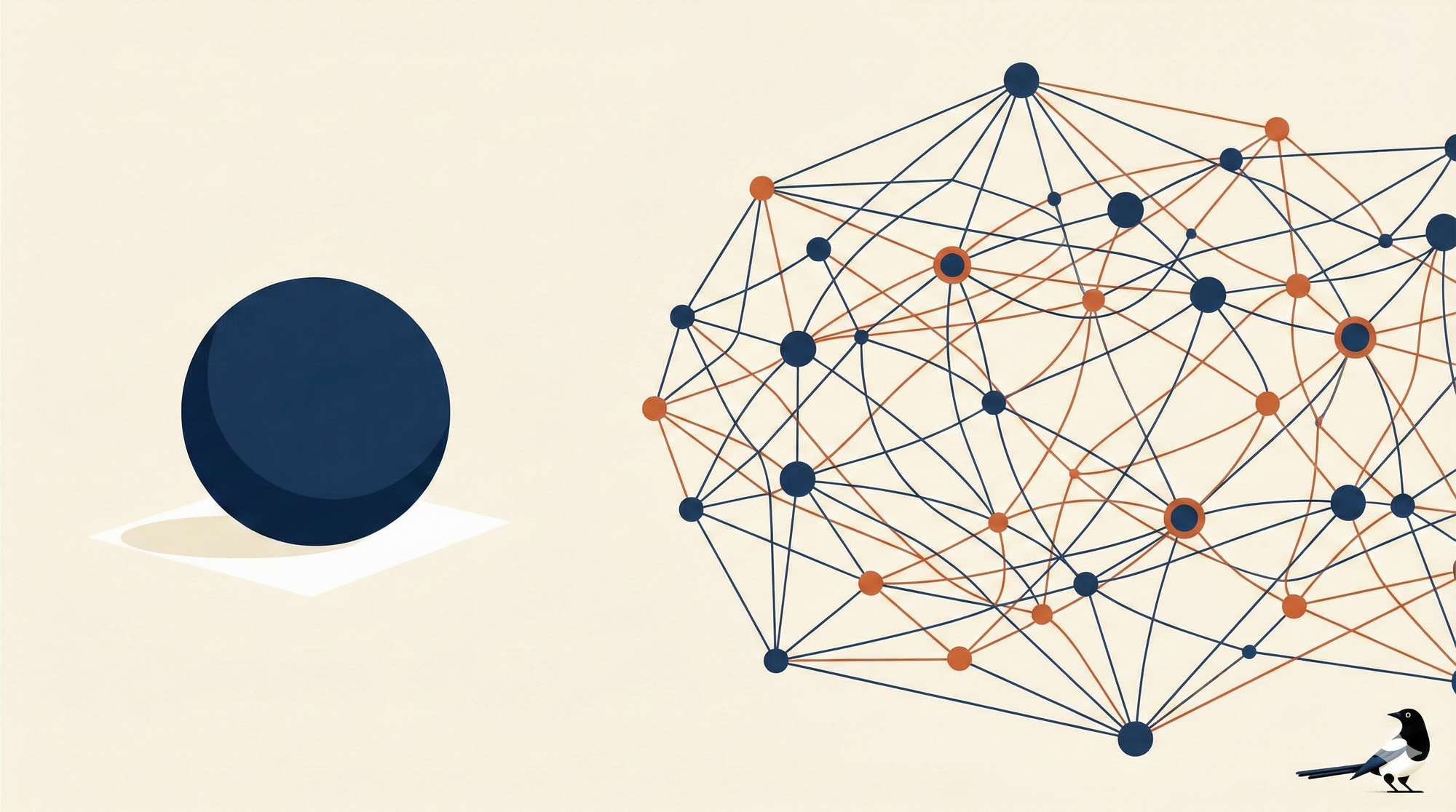
Product thinking can't answer a relational question
Last month I wrote about the three layers of media strategy — content, product, service — and argued that service is the one most media ventures neglect and the one AI can't easily replace.
Until very recently, most of media strategy was about content and distribution. Then, product thinking came along, and it has been genuinely good for journalism. It has brought rigor, user focus, and a shared language for building things that resonate. I'm on the board of the News Product Alliance because I believe in it.
Product thinking is designed to optimize what you build. It centers the user as someone to build for, but not necessarily as someone you're in an ongoing relationship with. It's less equipped to answer a prior question: what commitment are you making to whom, and how does everything you build serve that commitment?
That's a service question. And there's an entire discipline, largely European, that's been working on it for fifty years while the journalism industry has kept building on earlier assumptions.
A Citibank executive named G. Lynn Shostack first articulated this gap in 1977 across the entire service economy.
Shostack drew a line between what people see and what makes it work
In 1977, Shostack published "Breaking Free from Product Marketing" in the Journal of Marketing. As a vice president at Citibank and running marketing for the investment management group, she watched her team and profession try to sell services using product tools built for tangible things like soap and cereal.
The dominant framework at the time was E. Jerome McCarthy's 4 Ps — Product, Price, Place, Promotion — codified in his 1960 textbook Basic Marketing.
Everything in the marketing canon assumed that value was embedded in a tangible thing: something you could package, ship, and shelve.
Services that are intangible, perishable, often produced and consumed simultaneously (e.g. events) didn't fit. Yet by the late 1970s, services already accounted for a growing majority of GDP in the United States and Western Europe. The theory hadn't kept pace with the economy.
Shostack proposed an alternative she called the molecular model: instead of treating products and services as a binary, she placed marketed offerings along a continuum from tangible to intangible. The point was that almost everything people pay for is a mix of both, and the field was failing because it only had tools for the tangible side.
Five years later, in "How to Design a Service" (European Journal of Marketing, 1982), she used the term "service design" and introduced the concept of blueprinting: a visual, process-based method for mapping how a service actually gets delivered.
In 1984, she published a richer methodology in the Harvard Business Review ("Designing Services That Deliver"), laying out a two-dimensional flowchart divided by what she called the line of visibility: above it, what the customer sees; below it, the backstage operations that make the experience possible.
That line of visibility is incredibly useful for media strategy. A user journey map (a product tool many newsrooms have adopted) tracks what someone experiences. A service blueprint tracks that and everything behind it that makes the experience possible: staffing, systems, dependencies, failure points.
It forces you to think about the entire operation that surrounds the thing people experience, not just the story, but how someone discovers you, what happens after they read something, what recourse exists when something goes wrong.
I've found that most media ventures barely think about this. The backstage (e.g. who responds when a member has a problem, what happens after someone finishes reading an investigation, how a tip from a reader actually gets routed) was never designed at all.
And without it, every interaction stays transactional: a one-time algorithmic discovery or article consumed. Some newsrooms may have found workarounds — games, puzzles, daily habits that keep people coming back — but habitual use without service clarity is retention without purpose.
The line of visibility is what helps you see where a transaction could become a relationship rooted in a service commitment. That's also where any sustained revenue lives.
Shostack's blueprinting methodology has been extended by subsequent scholars (e.g. Mary Jo Bitner added layers for physical evidence and support processes).
Shostack gave the field a foundation. What happened next split along continental lines (this is just my reading of what happened), and that split matters for journalism today.
One school focused on measurement, the other on relationships
While Shostack was pushing against tangible product-centric thinking from inside American banking, a parallel tradition was forming on the other side of the Atlantic with different premises.
In the United States, one response to Shostack's challenge was to build more measurement instruments. A. Parasuraman, Valarie Zeithaml, and Leonard Berry published their conceptual model of service quality in 1985 and operationalized it in 1988 as SERVQUAL, a 22-item questionnaire that measured service quality across five dimensions: reliability, assurance, tangibles, empathy, and responsiveness. It became the most widely used standardized instrument for measuring service quality. The instinct was American: if you can't measure it, you can't manage it.
In Finland, Christian Grönroos at the Hanken School of Economics was reaching different conclusions. His 1984 paper in the European Journal of Marketing distinguished between technical quality (what the customer receives, i.e. the outcome) and functional quality (how the service is delivered, i.e. the process).
Where the Americans built surveys, the Nordic School of Service Marketing emphasized relationships, interactions, and the idea that every employee is a "part-time marketer."
These methodological differences reflected divergent assumptions about what a service is for. The American tradition treated service quality as something to be captured by formalized instruments and optimized through management. The Nordic tradition treated it as something embedded in ongoing relationships and organizational culture.
I think about this split when I see journalism practitioners debate metrics. Because of the information ecosystems we find ourselves in and where they are from, we may have overly adapted to the former school's instincts: measure reach, measure engagement, measure conversion.
The question the Nordic school was asking ("what kind of relationship are you actually maintaining?") feels secondary. Yet it's the question that would help a local newsroom figure out whether its membership program is actually appreciated by participating members, or if it's just desperately extracting payment from well-intentioned supporters.
The difference also matters commercially: a member who feels served renews, refers others, and increases their support. A member who feels extracted from cancels the moment money gets tight.
From a marketing problem to a design problem
The move from studying services as a marketing problem to treating them as a design problem happened in Germany.
In 1991, Michael Erlhoff, the founding dean of the Köln International School of Design (KISD), proposed that design should extend beyond giving form to objects to encompass the design of services. By his own account, almost nobody understood what he meant.
In 1995, he found a collaborator in Birgit Mager, who had worked in organizational development for companies like Hewlett-Packard. She was appointed the world's first professor of service design at KISD. Together with Ezio Manzini, they published Dienstleistung braucht Design in 1997, one of the earliest books on the subject.
Mager spent the next decade building the field's institutional infrastructure: curricula, industry partnerships with Deutsche Bank, Siemens, and Lufthansa, and in 2004, the co-founding of the Service Design Network (SDN) as a collaboration among institutions incl. KISD, Carnegie Mellon and the Politecnico di Milano. The SDN held its first global conference in Amsterdam in 2008, started a journal dedicated to service design practice called Touchpoint in 2009, and it's also where I'm learning all this.
Also in 2004, marketing scholars Stephen Vargo and Robert Lusch published the widely-cited "Evolving to a New Dominant Logic for Marketing" in the Journal of Marketing. Their service-dominant logic argued that service (the application of knowledge and skills for the benefit of another) is the fundamental basis of all exchange. Value isn't embedded in products. Value is co-created between providers and beneficiaries in that moment.
This gave service design a theoretical backbone that converged, from a different intellectual tradition, with what Grönroos and others had been arguing for twenty years.
For journalism, the implication is uncomfortable: a story has no value until someone chooses to engage with it. Value doesn't live in the article or its distribution or its passive consumption.
It emerges in the interaction between what we publish and what someone does with it. And when that interaction leads to a decision made, a problem navigated, or a situation understood, that is when someone will spend time, pay, donate, or advocate on your behalf.
Public services forced the question: design for whom?
The Nordic countries brought something to service design that American marketing theory couldn't supply: a political economy organized around universal public services.
In countries where healthcare, education, and childcare are provided as citizenship rights, and where trust in government is among the highest globally, the design challenge is less about maximizing consumption and more about making large-scale systems work for everyone.
While these precious conditions may have produced the discipline, the tools travel. Service blueprinting can bring crucial insights whether you're redesigning Finnish public healthcare or figuring out why a Cape Town newsroom's members don't renew.
In Europe, this produced institutions with few American equivalents (at least, that I know of). Denmark's MindLab embedded designers, ethnographers, and policy specialists within government ministries to redesign public services. Finland's national innovation fund Sitra created the Helsinki Design Lab. Norway launched StimuLab, applying service and systemic design to public challenges.
All of these drew on a Scandinavian tradition of participatory design and the idea that the people affected by a system should help shape it. That tradition started in workplaces in the 1970/80s, with projects like DEMOS in Sweden and UTOPIA across Sweden and Denmark, where unions and researchers developed methods for workers to co-design the technologies being imposed on them (core principles: democracy in design, engagement with values, treating conflict as a resource).
The Danish Design Ladder crystallized this framing. Developed by the Danish Design Centre in 2001 and published in a national survey by Anders Kretzschmar in 2003, it defines four levels of design maturity:
- non-design,
- design as styling,
- design as process, and finally
- design as strategy. This is the highest level, in which designers work with leadership to rethink what an organization is actually for.
The Design Ladder was a policy instrument, a way for a small-ish European country to articulate design as economic strategy rather than aesthetics. It's hard to imagine it emerging from the American design consultancy ecosystem, where design tends to be framed as a service you buy rather than a capability you build.
(Helsinki Design Lab wound down in 2013; MindLab closed in 2018. These closures show how hard it is for design-led thinking to survive even inside Nordic institutions.)
If you applied the Design Ladder to most news organizations, the honest answer is that they're stuck between steps one and two: design as non-design or design as styling (how almost every newsroom executive dreamed of having their own "Snow Fall"). A few have reached step three, design as process (esp. amid the current funding crunch). Almost none operate at step four, where design informs what the organization is actually for.
The participatory tradition offers concrete methods for this, most of all genuinely involving the people you claim to serve in shaping what you do, not through a reader survey or a comments section, but as co-designers of the service itself.
Most newsrooms have never encountered these methods or see them as part of their work. It should not come as a surprise that many of the most successful creators center this in theirs.
Service design worked when someone gave it authority
Marc Stickdorn and Jakob Schneider's This Is Service Design Thinking (2010) was the first widely accessible introductory text: principles, methods, and international case studies. It became a gateway for students and practitioners encountering the field for the first time. An enjoyable sequel, This Is Service Design Doing, followed in 2018.
The most consequential institutional development of this period was the UK's Government Digital Service (GDS), formed in April 2011. GDS replaced over 1,800 government websites with a single platform (gov.uk), published 10 design principles emphasizing user needs, and introduced a service standard requiring teams to move through discovery, alpha, beta, and live phases. It saved over £4 billion.
GDS demonstrated that service design could operate at national scale, not as a consultancy engagement but as a permanent government capability. Its model was replicated by the US Digital Service, Australia's Digital Transformation Agency, and others.
There's a lesson here for journalism organizations that claim to serve the public interest: the UK government did not improve public services by running a design thinking workshop and then going back to business as usual. It built a permanent team, gave it authority, and measured outcomes, not just satisfaction scores or engagement metrics, but whether the service actually worked for the people using it.
Most newsrooms that have tried "design thinking" got the workshop — the Post-it notes, the empathy maps, the two-day "strategy" offsite.
What they didn't get was a mandate to actually change how the organization works. So the insights sat in a slide deck, and six months later everyone was back to optimizing what they were already doing.
Why journalism hasn't used any of this
So there is an entire discipline that is fifty years old and is taught at universities across Europe, applied successfully in healthcare, government, and finance and that thinks rigorously about how intangible services work, fail, and get designed. And the journalism industry, which is arguably more intangible and more relationship-dependent than any of them, lives on another planet.
The objection I keep hearing, especially in Europe, is this: "That's American/capitalist/tech-bro thinking! We're different, unique and very special! Journalists here just know how to do their work, and that's how we have liberal democracy!"
The thinking goes: journalism can't be conceptualized beyond questions on format and distribution because an abstraction of "news" it creates is seen as a natural part of our political and cultural systems. We just need to subsidize creators of "news" content and all will be well again (it never was).
Looking too closely at what it actually does and who makes decisions is akin to censorship. The argument is that we can trust that this organic form of journalism creates an automatic corrective.
I understand the real dangers of flawed media regulation and, worse, state control. But I also think it's fatally wrong. Two things can be true, and this isn't a binary choice.
The irony is that service design isn't Silicon Valley product thinking. It's largely European. You can study it at dedicated master's programs in Cologne/Germany (where it started), Lucerne/Switzerland, Linköping/Sweden, Aalto/Finland, Milan/Italy, London/UK, and through a joint Erasmus Mundus program across Latvia, Finland, and Estonia.
This is an established European academic discipline, not a consultancy fad. And the European instinct to just subsidize "news" without examining what it does? That's not an anti-capitalistic supposedly superior European alternative to American product thinking. It's self-righteous (or self-serving) avoidance of strategic thinking altogether, and it ignores an intellectual tradition that grew from European soil.
The argument that public interest information should be understood as infrastructure (comparable to water systems or roads) rather than as a sector to be subsidized has been building for a while (e.g. MDIF's Patrice Schneider sees it play out globally). The reframing shifts the question from "who produces the content?" to "what does the information system do for people?" from form to function.
This opens up funding models that go beyond philanthropy: public-private partnerships, long-term policy instruments, blended capital.
This also challenges the self-image of journalism as an intellectual warrior class that needs to be sustained by philanthropists. That model produces something closer to the Swiss Guard watching the pope with their impressive costumes and once-intimidating halberds, and not actually securing much of anything.
The problem has been getting to clarity. I see service design as one way. Information infrastructure requires maintenance, failure detection, and a designed experience for the people who depend on it.
You don't just build a water system and hope it works. Someone has to plan how it reaches people, what happens when it breaks, and how it adapts when conditions change. That's service work. If public interest information is infrastructure, it needs service thinking.
We already have starting points for what that infrastructure could cover: The critical information needs (emergencies, health, education, transportation, economic opportunities, environment, civic life, public safety; pdf) could give us the topical fields.
And the work of maintaining them can be mapped through what Megan Lucero and the Journalism + Design Lab at the New School call "community news roles": documenting, sense-making, inquiring, navigating, facilitating, amplifying, enabling, commenting.
These describe what people actually do with information regardless of whether they hold a press pass. Service design can help understand how effectively these roles are being performed, where the gaps are, and what it takes to sustain them.
A framework that defines public interest information by function rather than by institutional form makes it possible to fund what works and stop funding what doesn't, without anyone having to decide what counts as "real" journalism.
Without a differentiated understanding of what the craft of journalism actually can do, governments and philanthropists end up funding special interest groups, as my home country Austria does, where millions in press subsidies annually flow to outlets that polarize society.
This kind of specificity gets us out of a false binary. Right now the debate is stuck between "subsidize journalism" and "let the market decide," and both fail.
In this, I find the tools service design produces — stakeholder mapping, service blueprinting, jobs-to-be-done analysis, journey mapping — are less important as methods than as conversation starters for media strategy.
They get people in a room talking about strategy instead of talking about the next piece of content or the next feature (which in turn becomes a giant smokescreen for influence peddling and ulterior motives).
None of this could ever turn journalism into a deterministic science. But we now do have many puzzle pieces for really thoughtful conversations both at the level of an individual media venture's strategy and at the ecosystem level, where the analysis can finally go beyond generic understandings of "news" in a given place.
Service design has transformed healthcare delivery, government services, and financial products. Journalism hasn't had its turn. That's an opening, and for any ventures willing to go there, the reward is concrete: the organizations that figure out how to design and maintain a genuine service commitment are the ones people and collectives of people will pay to keep.
Shostack saw the mismatch before I was born on the other side of the Atlantic: an economy dominated by services, served by frameworks built for goods. Nearly fifty years later, journalism is living the same lag. We're a service-dependent craft operating almost entirely in content-and-product mode.
The question is whether we'll use the tools that already exist before the gap between what we produce and what people actually need becomes unfillable.
Looking back
Madison Karas and I published an op-ed on Source (OpenNews) about a pattern we keep seeing at journalism conferences: the same faces presenting the same slides about the same problems to the same audience.
The go-to example to me is the International Journalism Festival in Perugia where the side gatherings, the dinners, and the access economy around the main event are a bit of a bubble that benefits everyone already in the business. I'm not sure that's a good thing.
We want to keep this conversation going and learn about what could work. Join us for the OpenNews Community Call this Thursday, February 26 to talk about designing better gatherings. Absolutely everyone is welcome.
Thanks to Mark for the reading recommendation for “The Art of Gathering: How We Meet and Why It Matters”. Any others are very welcome!
Looking ahead
Philadelphia service design workshop — apply by Friday, February 27. Madison and I are running a one-day service design sprint on March 18 for U.S.-based news organizations and independent creators in Philadelphia, with support from the Lenfest Institute.
At ONA26 in Chicago, we will be offering individual Service Desk check-ins for conference participants — confidential 30-minute conversations about the service layer of your news organization.
We're seeing a lot of people come in to discuss increasing visibility, and the conversations often go deeper from there. If you'll be at ONA, claim a slot in our Calendly or via the conference program. Also, new virtual slots are available here.
Separately, I'll be presenting Gerald Hosp's Liechtenstein public media funding research in DC in mid-April (TL;DR why all the money in the world can't solve a conceptual media problem), more in the next edition. And I'm looking forward to joining the Hacks/Hackers AI conference in Baltimore in May to share some of my team's research in Iran.
Some of it centered on perceptions of trustworthiness among GenZ Iranians in the YouTube creator space and will be released in the coming weeks. I just learned that our findings and the subsequent strategy changes have significantly increased the reach of our partners at Factnameh, which in this moment of constant algorithmic uncertainty feels amazing.
Thank you for reading. If you work in strategy, or with someone who does, I hope some of this history is useful. I'd be grateful if you passed it along.
If any of this sparked a thought, I'd love to hear it. Signal at patrickb.01 or reply to this email.
Until next month.
Impact metrics: Zero grant narratives embellished. Zero theories of change that changed nothing but spawned new WhatsApp groups. Zero conferences where the same people agree with each other again. One promise kept: This arrived in your inbox.